

A participant in one of our coach training cohorts asked me something that most people are quietly thinking but rarely say out loud: “I’ve been coaching for three years. My clients get results. So why do I actually need this credential?”
It was a fair question. And the honest answer is – she might not need it right now, for the reasons she thought she did.
That’s the problem with most conversations around ICF certification. People either frame it as an obvious yes – a badge that unlocks professional legitimacy or dismiss it as an expensive formality. Neither of those positions holds up when you actually look at what the certification delivers, what it doesn’t, and whether any of that lines up with where you’re trying to go.
This piece is an attempt at a more honest answer. Not a sales pitch for coaching education, not a discouraging reality check. Something more useful than either – a look at what the certification actually does, for whom, and what questions you should really be asking before you commit to it.
What the ICF Credential Actually Signals
Worth getting this out of the way early, because it shapes everything else.
ICF certification does not certify that you’re a good coach. Say that to some coaches and they bristle – but it’s just what any professional credential can and can’t do. What it does certify is that you went through a structured, supervised process. You trained with an accredited programme. You logged real hours coaching real people. You sat a competency assessment and passed it. You understand the ethical framework that governs how professional coaches are supposed to operate.
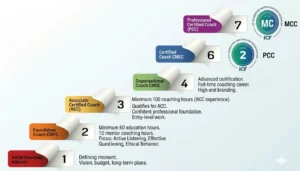
The hours involved are substantial. ACC – the entry-level credential – requires 60 hours of accredited training and 100 coaching hours. PCC raises that to 125 training hours and 500 coaching hours, plus a recorded session evaluation. MCC, the top tier, is a different thing entirely: 200 training hours, 2,500 coaching hours, and an assessment process that takes years to be ready for.
What that process produces, when it’s done properly, is a coach who’s been put through something real. Not someone who watched videos and answered quiz questions. Someone who has coached under supervision, received feedback on their practice, and been measured against a defined standard of competence.
When an HR head at a company sees an ICF credential, that’s what it signals. Not brilliance. Not a guaranteed experience. Just: this person did the work. That’s actually a meaningful thing to communicate – especially in an industry where anyone can print a business card that says “coach.”
What ICF Certification Is Not
This is worth saying plainly, because many people come into coach training with expectations that the credential alone will reshape their practice or career.
ICF certification is not a client acquisition tool. In India, where the coaching industry is still maturing, the general public – including many mid-level managers and individual clients – rarely asks whether their coach is ICF credentialed. The credential operates more as a tiebreaker and a trust marker in formal, enterprise, or international contexts, not as a broad marketing signal.
ICF certification is not a substitute for experience. The hours you log toward your credential are part of what makes the process valuable. But the credential itself, once earned, doesn’t automatically confer expertise. Coaches who treat the credential as the destination rather than a milestone tend to plateau. Those who treat it as a checkpoint in an ongoing development journey tend to keep improving.
And ICF coaching certification is not the same as building a coaching business. Those are two separate problems. Many coaches earn their ACC, get their certificate framed, and then realise they still have no idea how to attract and retain clients. The credential opens certain doors. Getting through them is a different challenge entirely.
Knowing what the certification can’t do is just as important as knowing what it can, before you decide whether the investment makes sense.
Where ICF Certification Is Genuinely Worth It
The value isn’t abstract – it lands in specific situations. Here’s where it actually makes a difference.
Corporate coaching is the clearest case. Multinationals and growth-stage companies with proper L&D functions have started specifying ICF credentials in their vendor requirements and internal coaching role profiles. This wasn’t true five years ago. It is now. If you’re coaching inside an organisation – or pitching to one as an external partner – the credential has quietly moved from “nice to have” to “expected.” Not everywhere, not yet. But in enough places that going without one is a real disadvantage.
International work is where the credential becomes close to non-negotiable. The ICF is recognised in more than 150 countries, which means your credential means the same thing to a client in Singapore or Dubai as it does to one in Mumbai. When you’re trying to establish trust in a new market without a local reputation to lean on, that shared standard is genuinely useful. Building credibility from scratch in every new geography is slow. The credential shortcircuits some of that.
The benefit that tends to get buried in these conversations is the developmental one. The ICF’s core competencies – the way they define presence, active listening, powerful questioning – aren’t just boxes to tick for an assessment. They’re a serious model of what good coaching actually looks like. Going through an accredited programme, especially one with strong mentoring and supervision, forces you to confront habits you didn’t know you had. The tendency to problem-solve when the client needs space. The way you jump to a question before the previous answer has really landed. Most coaches, once they’ve been through proper ICF training, describe their coaching before it as something almost unrecognisably different. The credential is the paperwork at the end of that process. The growth is what you actually paid for.
Healthcare coaching, institutional coaching, executive engagements with listed companies – these environments are increasingly asking for verifiable credentials before they’ll engage a coach at all. In risk-conscious or compliance-aware settings, the ICF framework provides a form of institutional assurance. Without it, you may not even get the conversation.
Who Should Think Carefully Before Committing
Not everyone should be running toward this right now. That’s worth saying directly.
Someone who has never coached a single person probably shouldn’t enrol in an ICF programme yet. The training is designed to develop coaching skills you’re already beginning to use – it’s not a foundation course that teaches you what coaching is from scratch. The supervised hours requirement means you’ll need to be actively coaching people throughout the programme. Without some prior experience, the learning doesn’t have much to anchor to. Spend a few months coaching informally first. Peer coaching, pro bono work, internal coaching in your current organisation. Get enough reps that the training actually has something to sharpen.
There’s also an honest financial question. ICF-accredited programmes are not cheap, and the return timeline is measured in years, not months. The credential opens doors, but those doors still need to be walked through, and building a coaching practice takes time regardless of your credential status. If your current coaching income is minimal and you’re looking at a significant programme fee, it’s worth asking whether this is the right moment – or whether building the practice a little further first, then investing in the credential from a slightly stronger financial base, makes more sense.
None of this means “don’t do it.” It means the timing matters as much as the decision itself.
The Real ROI Calculation
The money question is real, so let’s treat it seriously rather than gloss over it.
A good ICF-accredited Level 1 programme in India will cost you somewhere between ₹1.5 lakhs on the lower end to around ₹5–6 lakhs for programmes with strong international faculty or more intensive supervision structures. That’s a real number. Add credential application fees, mentor coaching costs if they’re not bundled in, and the time cost of logging 100+ coaching hours – and the total investment is meaningful.
What does it buy you? In corporate contexts, credentialed coaches typically command significantly higher fees than non-credentialed ones. Enterprise coaching engagements – working with senior leaders in large organisations – are often priced at ₹10,000 to ₹25,000 per session, sometimes more depending on the seniority of the person being coached. Coaches without a recognised credential often find that formal procurement teams apply a discount to their rates or skip them entirely. The credential doesn’t create that gap, but it removes one of the main justifications for it.
The break-even math is not complicated. Two or three corporate engagements that the credential helped you win, at those rates, cover the programme cost. The challenge is that those engagements don’t appear on day one after you receive your certificate. There’s a lag – sometimes six months, sometimes longer. The credential changes how people perceive you; your pipeline takes time to reflect that.
There’s also something the pure financial calculation doesn’t capture. Many coaches who go through rigorous accredited programmes describe something shifting in their practice well before they receive their credential. The supervised hours, the mentor coaching feedback, the experience of having your coaching sessions evaluated against the ICF competency framework – these things change how you show up in sessions. That change is permanent. The credential is the document that records it; the actual value lives in the work.
ICF Level 1 vs Level 2: Which One to Go For
A question that comes up constantly: should you aim for ACC or go straight toward PCC?
The honest answer is that most coaches should start with Level 1 (ACC pathway) and let the credential serve its purpose at that stage before making the decision to go further.
The ACC credential is sufficient for most corporate contexts, particularly in India. It demonstrates serious commitment to the profession, signals competency, and satisfies the threshold requirements for the majority of organisational coaching engagements. Pursuing Level 2 (PCC pathway) makes sense when you’ve accumulated significant coaching experience, when your client work genuinely demands the additional rigour, or when you’re building toward international practice or MCC in the longer term.
What rarely makes sense is rushing toward PCC before you’ve earned the hours and the experience that make the credential meaningful. The ICF’s hour requirements aren’t bureaucratic boxes – they exist because there’s no substitute for the developmental effect of actually coaching that many people.
What to Look For in an ICF Accredited Programme
Not all ICF-accredited programmes are equivalent, and the variance is significant. Here’s what actually separates programmes that develop coaches from programmes that just deliver credentials.
The starting point is whether the programme is accredited at ACTP (now Level 2) or ACSTH (Level 1) standard. That determines the pathway and what’s included. But within those categories, the quality differences are real.
Look for a programme that emphasises coaching practice, not just coaching theory. The ICF competencies can be intellectually understood in a few days of study. The challenge is embodying them in actual coaching conversations – and that requires supervised practice, feedback, and repetition over time. A programme that’s heavy on content delivery and light on practice sessions is not a good investment.
Mentor coaching matters too. ICF requires 10 hours of mentor coaching for ACC; more for PCC. Some programmes treat this as a checkbox. Good ones treat it as the centrepiece of your development – a systematic examination of your coaching through a skilled lens, with specific feedback that you can act on.
Finally, look at who’s doing the facilitation. The quality of the coach educators in your programme will shape your development significantly. Facilitators who are actively coaching, who carry senior credentials themselves, and who can bring real case material into the learning environment will develop you in ways that pre-recorded modules can’t.
Is ICF Certification Worth It in India in 2026?
The India-specific question deserves a direct answer.
The coaching industry in India is growing, but it’s at a different stage of maturity than markets in the US, UK, or Australia. Credential awareness at the individual client level is still limited. But at the enterprise level – and in particular among HR functions in large organisations, L&D teams with global mandates, and leadership development programmes designed around international frameworks – ICF credentials are increasingly being specified.
The trajectory is clear: credential requirements in formal coaching contexts in India are rising, not falling. If you’re planning a serious coaching practice over the next five to ten years, the question isn’t whether ICF certification will matter in that environment. It’s whether you want to pursue it now, from a position of early-mover advantage, or later, when the market’s expectations have already moved.
The coaches who will be most credibly positioned in the Indian coaching landscape in 2030 are probably the ones earning their credentials today.
Q: Is ICF certification mandatory to practise as a coach in India?
No. There is currently no regulatory body that requires coaches in India to hold a credential in order to practise. Anyone can call themselves a coach. ICF certification is a voluntary professional credential - but in formal and enterprise contexts, it is increasingly expected, not just preferred.
Q: How long does it take to get ICF certified?
For ACC, most coaches complete the training portion in four to six months and then log the required coaching hours over the following six to twelve months. The full process typically runs nine to eighteen months from enrolment to credential. PCC takes considerably longer - usually two to four years of committed practice, given the 500-hour requirement.
Q: What's the difference between ICF-accredited programmes and non-accredited coaching courses?
ICF-accredited programmes are evaluated against the ICF's curriculum standards and lead directly to credential eligibility. Non-accredited coaching courses may teach useful things, but their hours typically cannot be counted toward ICF credentials. If ICF certification is your goal, the accreditation status of your programme matters from day one.
Q: Can I get ICF certified without completing a formal programme?
There is a portfolio path for coaches who have extensive prior training across multiple programmes. But for most coaches starting out, an ACTP or Level 2 programme is the more practical and efficient route.
Q: Does having an ICF credential guarantee more clients?
No. The credential creates professional legitimacy and, in certain contexts, gives you access to opportunities that are unavailable without it. But client acquisition is a separate problem - it depends on your positioning, your network, your niche, and your ability to communicate your value clearly. The credential supports those efforts but doesn't replace them.
Q: What is ICF ACC vs PCC - which should I choose?
ICF credentials are renewed every three years. The renewal process requires completing Continuing Coach Education (CCE) hours - 40 hours for ACC and PCC, including ethics training. It's a manageable requirement that also keeps your practice current. Most coaches who are actively coaching find the CCE hours accumulate through the supervision, peer learning, and professional development they'd be doing anyway.
A Final Thought
The most valuable coaching I’ve observed didn’t happen because the coach had letters after their name. It happened because the coach had developed genuine presence, real discipline in their listening, and the ability to hold space without filling it with their own thinking.
ICF certification, done through the right programme, develops those qualities. Not automatically. Not just by attending the sessions and logging the hours. But through the kind of structured, supervised, feedback-rich development that rigorous accredited programmes are designed to create.
That’s what makes the credential worth pursuing for coaches who are serious about the craft – not the credential itself, but what the process builds in you.
At BYLD Coaching, our ICF-accredited Level 1 and Level 2 programmes are built around that philosophy. Our approach, grounded in the InsideOut™ framework developed in partnership with Alan Fine – co-creator of the GROW® Model – is designed to develop coaches who produce results from the inside out: in themselves first, and then in the leaders and organisations they work with.
If you’re weighing whether ICF certification is the right move for where you want to go, we’d be glad to have an honest conversation about it – no pressure, just clarity.
Curious about whether our ICF coaching certification programme is the right fit for your goals? Talk to us at BYLD Coaching and let’s figure it out together.