

Let’s Be Honest About Executive Coaching in 2026
If you’ve been Googling career options lately, chances are executive coaching 2026 keeps popping up on your radar. And honestly, it makes complete sense. Between the post-pandemic reset of corporate priorities, the explosion of remote and hybrid leadership challenges, and a real hunger among senior professionals for meaningful guidance, the demand for skilled coaches has never looked more promising. But here’s the thing ,before you invest your time, energy, and a significant amount of money into this path, it’s worth having a genuinely honest conversation about what executive coaching in 2026 actually looks like from the inside.
This isn’t going to be one of those articles that just hypes you up with rosy projections. We’re going to walk through both sides ,the genuine opportunities and the honest challenges ,so that by the time you finish reading, you have a grounded sense of whether this career move makes sense for you right now. The coaching market in 2026 is maturing fast, and that creates both opportunity and responsibility for anyone entering it.
Whether you’re sitting in Bangalore wondering about executive coaching certification India programs, or you’re already a seasoned HR professional in Singapore, Dubai, or London considering a pivot ,this guide covers the territory thoroughly. Let’s dig in.
What Is Executive Coaching and Why Is It Booming Right Now?
At its core, executive coaching in 2026 is still about what it has always been: one professional helping another become a more effective leader. But the scope has expanded dramatically. Today’s executive coaches work with everyone from freshly promoted VPs who are drowning in their new responsibilities, to seasoned C-suite leaders navigating cultural transformation or digital disruption. The nature of these coaching engagements has also shifted ,from occasional hour-long calls to deeply embedded developmental partnerships that span six to eighteen months.
The numbers back this up. According to the International Coach Federation’s Global Coaching Study, 86% of companies report a positive return on investment from coaching, with an average ROI of around seven times the coaching fee.
Approximately 70% of coachees say their work performance improves meaningfully after engaging with a professional coach. These aren’t marginal gains. These are the kinds of results that make HR directors and CEOs keep writing coaching budgets.
What makes executive coaching 2026 different from what it looked like even five years ago? A few things stand out clearly. First, the shift to virtual coaching engagements ,accelerated sharply by the pandemic ,has fundamentally changed who can access coaching and who can deliver it. A coach based in Pune can now work with clients in Amsterdam, Nairobi, and Houston without anyone boarding a plane. Second, there’s been a genuine maturation of the field itself. Organizations are demanding more rigor, more measurable outcomes, and clearer accountability from their coaching investments. The era of ‘motivational conversations passing as coaching’ is fading fast.
Third ,and this is significant ,leadership itself has gotten dramatically more complicated. Managing multi-generational teams, handling burnout at scale, driving DEI initiatives with authenticity, leading through economic uncertainty across markets in India, the United States, the United Kingdom, and beyond ,all of this is creating sustained structural demand for skilled coaches who understand the realities of modern organizational life.
The Real Pros of Pursuing Executive Coaching as a Career
1. Work That Carries Genuine Meaning
Let’s start with the most human reason people make this switch. After decades in corporate roles ,managing P&Ls, sitting in strategy meetings, navigating office politics ,a lot of experienced professionals reach a point where they want their work to matter on a more personal level. Executive coaching 2026 offers exactly that. Every coaching engagement is fundamentally about helping another person grow. You’re sitting across from someone who is genuinely struggling ,maybe they’re brilliant technically but keep alienating their team without realizing it, or maybe they’re paralyzed by imposter syndrome at a moment when their organization needs them to step up. And you help them see what they can’t see on their own.
2. Strong Income Potential ,Especially in the Indian Market
Depending on your experience, niche, and the seniority of clients you’re working with, an established executive coach in India can earn anywhere from ₹5,000 to ₹25,000 per hour for individual sessions. Corporate retainers ,where you’re embedded with an organization to work with multiple leaders over several months ,can range from ₹3 lakh to ₹15 lakh or more per coaching engagement, depending on scope and seniority. Coaches who specialize in high-stakes niches ,like C-suite transformation, IPO readiness, or cross-cultural leadership in multinational environments ,command considerably higher fees. In mature markets like the United States, the United Kingdom, and Australia, these figures are even higher. Executive coaching in 2026 has a compelling economic argument, particularly once you’ve built your reputation.
3. Flexibility That Corporate Life Rarely Offers
One of the things independent executive coaches consistently mention when asked about their career shift is the freedom. You set your own calendar. You choose which clients to work with. You decide whether to focus your coaching engagements in a particular sector ,banking and financial services, technology, manufacturing, healthcare ,or whether to work across industries. That kind of autonomy is genuinely rare, and for people who’ve spent twenty-plus years in structured corporate environments, it can feel almost startling at first.
4. The Market Is Growing ,Especially in Asia and India
Here’s something that doesn’t get discussed enough in conversations about executive coaching 2026: the geography of opportunity is shifting. While North America and Europe have traditionally dominated the market, places like India, the UAE, Singapore, and parts of Africa are seeing rapid demand growth for professional coaching. Indian organizations ,especially large conglomerates, MNCs with significant India operations, and the booming startup ecosystem ,are increasingly allocating serious budgets for leadership development and coaching engagements.
This is partly why interest in executive coaching certification India has increased so sharply. More professionals within the country are recognizing they can build coaching careers locally, serving the Indian market, without needing to relocate or orient exclusively toward Western clients. The domestic opportunity is real and growing, and it rewards coaches who understand local corporate culture deeply.
5. Your Corporate Experience Is Your Biggest Asset
Unlike a lot of career transitions that require you to start from scratch, moving into executive coaching in 2026 actually rewards everything you’ve built. The deeper your corporate experience ,the more difficult decisions you’ve navigated, the more complex organizational situations you’ve survived, the more diverse teams you’ve managed ,the more credibility you carry. A coach who has personally led a business unit through a financial crisis, or driven a major digital transformation, brings something to the table that pure academics simply cannot replicate.
6. The Global Remote Opportunity Has Opened New Doors
One underrated benefit of the virtual shift in executive coaching in 2026 is the geographical freedom it gives coaches. You’re no longer restricted to clients within commuting distance of your city. Coaches in Chennai are running coaching engagements with clients in Frankfurt. Coaches in Ahmedabad are working with senior leaders at companies headquartered in New York. The virtual delivery model has genuinely democratized access to the global coaching market in a way that didn’t exist before 2020.
The Honest Cons ,What People Don’t Tell You
1. Building a Client Base Takes Longer Than You Think
This is probably the biggest reality check for people transitioning into executive coaching 2026. The assumption is: I have twenty years of experience, a strong network, maybe some credentials ,clients will come. And they will, eventually. But ‘eventually’ often means twelve to twenty-four months of genuinely grinding through referral conversations, speaking engagements, content creation, and real uncertainty about when the next coaching engagement is coming. Most successful coaches talk about a ‘desert period’ in their first year where they’re doing the work of building visibility without seeing proportionate financial returns. Planning your finances for this transition period isn’t optional ,it’s essential.
2. The Certification Landscape Is Genuinely Confusing
If you start researching executive coaching certification India options, you’ll quickly discover the market is flooded. Programs range from weekend workshops to twelve-month intensive certifications, from ICF-affiliated programs to proprietary methodologies with no external validation. Cost ranges are equally wide ,from a few thousand rupees for an online course to upwards of ₹5–10 lakh for premium programs from established institutions. The honest truth: credentials matter, but not equally in all contexts. If you want to work with large corporations that have formal procurement processes, ICF accreditation becomes close to table stakes. If you’re building a boutique practice through personal referrals, your reputation and demonstrated results may matter more than any certificate.
3. Isolation Is a Real Occupational Hazard
Executive coaching can be lonely work. When you’re running individual coaching engagements as an independent practitioner, there’s no office culture, no team meetings, no colleagues to grab lunch with. You spend large portions of your day in deeply focused one-on-one conversations ,which are rewarding ,but outside of those sessions, many coaches find themselves missing the social texture of organizational life more than expected. Many address this by deliberately building community ,joining peer groups, getting involved in professional associations, partnering with other coaches on organizational projects.
4. Managing the Business Side Is a Full-Time Job in Itself
When you work inside a corporation, you don’t think about invoicing, contracts, tax filings, marketing, proposal writing, or client relationship management in the same way. When you become an independent executive coach, all of that lands squarely on your plate. Some people genuinely enjoy the entrepreneurial aspect. Others find it draining and distracting from the coaching work they care about. This is one reason some coaches choose to affiliate with coaching firms that handle business development, accepting lower per-engagement revenue in exchange for steadier client flow.
5. The Emotional Weight of the Work Is Significant
Executive coaching engagements involve deep, often emotionally complex conversations. Your clients aren’t just bringing you business problems ,they’re bringing their fears, insecurities, relationship difficulties with colleagues and direct reports, and career anxieties. Holding space for all of that, session after session, requires tremendous emotional resources. Sustainable executive coaching in 2026 requires taking your own wellbeing as seriously as you take your clients’.
6. Income Unpredictability Can Be Stressful
Unlike a monthly salary, coaching income fluctuates. Some months you have multiple active coaching engagements running simultaneously and income feels strong. Other months a client finishes their program, a corporate retainer doesn’t renew, and suddenly you’re back in business development mode. Learning to manage feast-and-famine cash flow cycles is an essential survival skill for any independent coaching practice, and it’s one that takes most coaches a few uncomfortable years to fully get the hang of.
Who Is Actually Well-Suited for Executive Coaching in 2026?
Not everyone with corporate experience and genuine curiosity about human development should become an executive coach. The people who tend to thrive in executive coaching in 2026 share certain characteristics that are worth being honest about.
They’re deeply curious about what makes people tick ,not in a casual, superficial way, but genuinely interested in the underlying psychology, belief systems, and behavioral patterns that shape how leaders show up. They can sit comfortably with complexity and ambiguity, without needing to resolve everything into neat answers. They have high emotional intelligence ,not just awareness of their own emotions, but genuine skill in navigating others’ emotional states without getting lost in them.
They’re also patient with non-linear progress. Coaching engagements rarely follow a tidy arc. Clients make progress, then backslide, then make more progress. Coaches who need clean, linear improvement get frustrated quickly. The ones who understand that sustainable behavioral change is messy and iterative ,those are the ones who stay in the game long-term.
And practically speaking, they have a strong enough financial cushion and network to survive the client-building phase without panicking. If you’re entering executive coaching 2026 with three months of savings and no clear prospect of clients, you’re setting yourself up for unnecessary stress that will actually undermine your coaching presence and effectiveness.
An Executive Coaching Career Roadmap That Actually Makes Sense
If you’ve read this far and you’re still interested, let’s talk about a realistic executive coaching career roadmap. Not the idealized version ,the version that acknowledges where the friction points are and how to navigate them practically.
Phase one is foundation-building. This typically spans the first six to twelve months and involves getting your core credentials in order ,deciding which certification pathway makes sense given your goals (ICF-accredited programs are generally the safer bet for corporate credibility), completing required training hours, accumulating supervised coaching practice hours, and starting to clarify your niche. What kind of leaders do you most want to work with? What organizational challenges do you have the most genuine insight into? This is also the period for experimentation ,pro bono coaching engagements with people in your network, informal advisory conversations that help you refine your approach and understand your natural strengths as a coach.
Phase two ,roughly months twelve to thirty-six ,is where the business actually starts taking shape. By now you have some testimonials, some case studies (appropriately anonymized), and a clearer sense of your positioning. You’re starting to generate referrals, perhaps writing or speaking publicly about leadership themes that demonstrate your perspective, and having real commercial conversations about paid engagements. This phase tests your patience and resilience in ways that are genuinely character-forming.
Phase three ,beyond year three ,is where executive coaching 2026 really opens up. By this point, if you’ve done the work, you have a reputation in a specific space. You can be selective about clients, command higher fees, and potentially start training other coaches, creating group programs, or moving into organizational consulting work. The second executive coaching career roadmap element most people underestimate is the importance of continuous learning. The best coaches never stop being coached themselves. They attend supervision, pursue advanced credentials, and read widely across psychology, organizational behavior, neuroscience, and leadership theory.
Executive Coaching Certification India: What You Need to Know
The question of executive coaching certification India programs deserves its own section because the landscape here is genuinely complex and evolving fast. India has seen a proliferation of coaching programs over the last five years, ranging from prestigious to frankly questionable, and knowing how to evaluate them matters enormously.
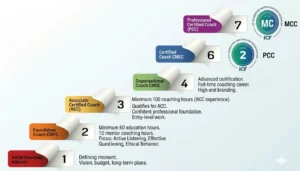
The International Coach Federation (ICF) is the most well-known credentialing body in the world. It offers three levels of credentials: ACC, PCC, and MCC. These require a mix of approved coach-specific training hours, verified coaching experience hours, and passing a test to get a certificate. There are a lot of ICF-accredited schools in India. Companies now run programs in person and online from places like Mumbai, Bangalore, Delhi, and Hyderabad. In India, a good ICF-accredited ACC-pathway program usually costs between ₹1.5 lakh and ₹4 lakh. Programs with higher levels and teachers from other countries can cost ₹5 lakh to ₹10 lakh or more.
In addition to ICF, groups like the European The Association for Coaching (AC) and the Mentoring and Coaching Council (EMCC) also offer internationally recognized certifications that are becoming more popular with Indian businesses. The main thing to remember if you want to get executive coaching in India in 2026 is to complete your research before signing up for any program. Ask alumni about what they really went through. , not just the marketing claims. The certificate you hold will matter ,make sure it’s from a program that earned it.
The India Opportunity: Why 2026 Might Be the Right Time
Let’s talk specifically about the Indian market for executive coaching 2026, because there’s a real story here that doesn’t get told enough in global coaching conversations.
India’s corporate sector is in the middle of a genuine leadership development reckoning. Organizations that spent decades promoting on the basis of technical performance are increasingly recognizing that leadership effectiveness ,the soft skills, emotional intelligence, capacity to inspire and retain talent ,is a competitive differentiator. The pandemic accelerated this realization painfully. Leaders who’d never managed remote teams, navigated mental health crises among their workforce, or communicated authentically during genuine uncertainty were suddenly required to do all three at once.
The demand for skilled coaching engagements in the Indian corporate market has grown meaningfully as a result. Large Indian conglomerates, MNCs with significant India operations, PE-backed companies preparing their leadership teams for growth, and even mid-sized family businesses navigating succession ,all are increasingly finding budget for coaching. The executive coaching 2026 opportunity in India is not yet saturated, which is encouraging for people considering the transition now.
There’s also a growing cultural acceptance of coaching in India that wasn’t totally there ten years ago. The notion that getting coaching means you’re weak or not good enough has gone down a lot, especially in bigger cities and in fields like technology, finance, and professional services. Top managers in Bangalore, Mumbai, and Hyderabad increasingly see having a coach as a marker of seriousness about their development. This cultural shift is a meaningful tailwind for anyone building a coaching practice in India today.
One nuance worth noting: the Indian market still rewards personal credibility and relationship-based trust in ways that credential-driven markets sometimes don’t. A warm introduction from a respected mutual contact is often worth more than any certification. This is true across many high-context relationship-oriented cultures, including parts of Southeast Asia, the Middle East, and Latin America. Building your network deliberately ,through genuine relationships, not transactional LinkedIn connections ,is especially important for coaches in the Indian market.
What the Most Successful Executive Coaches in 2026 Actually Do Differently
Certain patterns show up consistently among coaches who build genuinely successful practices in executive coaching 2026, as opposed to those who struggle to gain traction.
They specialize rather than generalize. The coaches who try to be everything to everyone tend to have the hardest time cutting through the noise. The ones who develop a genuine, specific point of view ,say, coaching first-generation promoters of family-owned businesses navigating leadership succession, or senior women leaders in financial services navigating performance and internal politics ,those coaches are far easier for the right clients to find and trust.
They invest seriously in their own development. The best executive coaches are perpetual learners. They read widely ,organizational psychology, behavioral economics, leadership research, neuroscience. They pursue their own coaching engagements with supervisors. They seek feedback from clients with genuine curiosity rather than defensiveness. The relationship between learning and effectiveness in this profession is unusually direct.
In executive coaching 2026, visibility is key. Not renowned for the sake of being famous, but a clear, consistent public point of view that informs potential clients what you believe in and how you think. Writing important articles, giving lectures at industry events, or having a well-curated professional internet presence could all be examples of this. People are more likely to hire coaches who are well-known for something than coaches who aren’t. end to get clients who are a better fit than coaches who aren’t visible.
They treat the business side seriously. Coaches who build sustainable practices run them as real businesses ,clear contracts, careful time tracking, deliberate follow-up systems, professional invoicing, and often some level of administrative support. Running your coaching practice as an informal side activity rather than a real business is the difference between a sustainable livelihood and a frustrating experience.
Quick Reference: Pros and Cons at a Glance
Here’s a condensed view to help frame the key dimensions when evaluating executive coaching in 2026 as a career:
PROS | CONS |
Meaningful, purpose-driven work | Slow client-building (12–24 months) |
Strong income: ₹5,000–₹25,000+/hr | Certification landscape is confusing & costly |
Flexibility and complete autonomy | Occupational isolation is real |
Growing demand in India and Asia | Business management overhead is heavy |
Corporate experience directly transferable | Emotional weight of deep relational work |
Global remote delivery opportunity | Income unpredictability, especially early |
Low overhead to start the business | No universal quality standard or accreditation |
Five Trends Shaping Executive Coaching in 2026
To build a lasting career in this space, you need to understand where the field is heading ,not just where it’s been. Here are five trends that anyone serious about executive coaching in 2026 should be tracking closely.
First: AI-augmented coaching tools are entering the space. Platforms that offer between-session support, mood tracking, habit reinforcement, and even AI-based coaching prompts are becoming real products that organizations are buying. This doesn’t replace skilled human coaches ,it actually creates opportunities for coaches who know how to position their work alongside these tools rather than in competition with them. Understanding the technology landscape is increasingly part of the job.
Second: group and team coaching is growing fast. Organizations are increasingly interested in coaching engagements that work at the team or cohort level, not just individual leaders. A coaching program that works with twelve senior leaders simultaneously ,building psychological safety, improving collective decision-making, addressing team dynamics ,delivers different but complementary value to individual coaching. Coaches who can facilitate this kind of group work well are increasingly sought after.
Third: integration with organizational development is becoming more common. The organizations that are getting the most from their investment in executive coaching 2026 are the ones that integrate coaching with broader leadership development infrastructure ,succession planning, performance management, culture transformation initiatives. Coaches who understand organizational systems, not just individual psychology, are better positioned to add this kind of integrated value.
Fourth: measurement and accountability standards are rising. The era of ‘trust us, coaching works’ is fading. Corporate buyers ,especially in larger organizations ,are increasingly requiring coaches to demonstrate measurable outcomes. Coaches who can define clear success metrics at the outset of coaching engagements and demonstrate progress against those metrics throughout are commanding both more trust and more budget.
Fifth, the mental health aspect is more important than ever. After the pandemic, people are more conscious of burnout, anxiety, and stress in leadership. This has given coaches more room to talk about the well-being aspect of effective leadership. This doesn’t mean that coaches are therapists; the line is very important. But by 2026, executive coaching will increasingly recognize that good leadership demands good health.
How to Price Your Coaching Services in India in 2026
One of the most awkward conversations for new coaches is the one about fees. Pricing feels deeply personal, partly because it’s tied to how you value yourself and your experience. But in the context of executive coaching in 2026, pricing is also a strategic decision that affects who you attract, how you’re perceived, and whether your practice is financially sustainable.
Here’s a general framework that works for the Indian market as it stands. Early-career coaches ,typically those with under three years of active coaching experience and an ACC-level credential ,typically charge between ₹3,000 and ₹8,000 per session for individual coaching engagements. Mid-career coaches with PCC credentials and a demonstrated track record in a specific niche can command ₹8,000 to ₹18,000 per session. Senior coaches with MCC-level credentials, strong corporate referral networks, and specializations in high-stakes leadership transitions often charge ₹18,000 to ₹35,000 per session or more.
For corporate retainers, which are the main way that many established coaches make money, the structure usually includes a set monthly cost that covers a certain number of sessions and allows for check-ins on an as-needed basis. Depending on the coach’s level of experience and how well-known they are in the industry, these retainers might cost between ₹50,000 and ₹2,00,000 per month for each leader being trained.
One pricing rule that competent executive coaches always stress is that you shouldn’t charge less in the hopes of getting more customers. It’s strange, but in the coaching market, pricing is often used as a stand-in for quality. Leaders who are used to paying ₹20,000 for a night at a five-star hotel without blinking occasionally think twice about paying ₹6,000 for a coaching session. It might be easier to sell to that market at ₹12,000 than at ₹6,000, because the greater fee changes the way people think about it. This isn’t a hard and fast rule, but it’s genuine enough to be worth thinking about when you set your first fees.
Mistakes New Executive Coaches Commonly Make ,And How to Avoid Them
Understanding the common pitfalls of early-career coaches can save you significant time, money, and frustration as you build your practice in executive coaching 2026.
The first and most common mistake is spending too much on certification before building any coaching practice. There’s a seductive logic here: ‘Once I have the credential, the clients will come.’ They won’t, at least not automatically. The credential matters, but your coaching quality, your niche clarity, and your network matter more in the early stages. Get credentialed, yes ,but don’t delay starting to coach until you have the perfect certification in hand.
The second mistake is trying to coach everyone. New coaches often think that a broad market position ,’I work with leaders at all levels, in all industries’ ,gives them more opportunity. In practice, it makes them invisible. Nobody in particular thinks of them when a coaching need comes up. Specialization feels risky at first but is almost always the faster path to a sustainable practice. Your experience in a particular industry or with a particular type of leadership challenge is a genuine differentiator, not just a nice-to-have.
The third mistake is underinvesting in supervision. Supervision ,where you work with an experienced coach to reflect on your coaching practice, not your personal life ,is one of the most valuable investments a developing coach can make. It accelerates your skill development, helps you catch blind spots before they become habits, and provides an ethical sounding board when you encounter complex client situations. Many new coaches treat supervision as optional. The ones who build the best practices treat it as foundational to everything else they do in executive coaching 2026.
The fourth mistake is neglecting business development until the pipeline runs dry. Consistent outreach ,having conversations, sharing perspectives publicly, staying present in the networks where potential clients and referral sources spend their time ,needs to be a weekly discipline, not something you do in a panic when your current coaching engagements are wrapping up. Building the habit of consistent, low-key business development during times of abundance is what prevents the feast-and-famine cycle that afflicts so many independent coaches.
So ,Is Executive Coaching a Good Career in 2026? The Honest Answer
Yes ,with meaningful qualifications.
For the right person, at the right stage of their professional life, with a realistic financial runway and genuine commitment to the craft, executive coaching in 2026 is not just a good career ,it’s an excellent one. The combination of purpose, income potential, autonomy, and intellectual stimulation is rare in any professional context. And the structural demand drivers ,leadership complexity, talent retention challenges, the premium on emotional intelligence ,are not going away. If anything, they’re intensifying.
But for someone primarily motivated by the prestige of the title, who underestimates the business-building challenge, who doesn’t have the emotional resources for deep relational work, or who is expecting immediate financial returns ,executive coaching 2026 will be genuinely disappointing. The gap between the romanticized version and the real version is significant, and it’s better to know that going in.
The question isn’t really ‘Is executive coaching 2026 a good career?’ The real question is: ‘Is executive coaching the right career for me, right now?’ And that requires honest self-assessment, not just excitement about the possibility. Talk to coaches who are actually doing it. Read widely. Experiment with pro bono coaching engagements before you fully commit. And if after doing all that it still feels like the right direction ,it almost certainly is.
If You’ve Decided to Move Forward: Practical Starting Points
Here are some concrete steps for anyone ready to take executive coaching in 2026 seriously as a career path:
- Research ICF-accredited programs in your city or region. Look for programs with strong alumni networks and verifiable placement records, not just impressive brochures. When researching executive coaching certification India options, talk to at least five program graduates before making any financial commitment.
- Start coaching before you’re ‘ready.’ The fastest way to learn is through practice. Offer pro bono coaching engagements to mid-level managers in your network. Ten real conversations will teach you more than any amount of theoretical training alone.
- Get coached yourself. If you haven’t experienced what it’s like to be on the receiving end of skilled coaching, you genuinely don’t know what you’re selling or delivering. Get a good coach and pay close attention to what they do and how they do it.
- Build your financial cushion before you quit. Most coaches suggest having 18–24 months of living expenses saved before transitioning out of employment. This isn’t pessimism ,it’s pragmatism that protects the quality of your coaching by removing financial desperation from the equation.
- Find a peer group early. Join ICF chapters, attend coaching conferences, connect with other coaches at different stages. This community will be your professional lifeline during the hard phases of building your practice.
- ]Clarify your niche early and revisit it often. Your niche will probably evolve as you get real client experience. But having some sense of who you serve best ,even an imperfect, provisional sense,will make every business development conversation considerably easier.
Final Thoughts: Executive Coaching in 2026 Is What You Make It
There’s no perfect moment to make a meaningful career transition. There will always be reasons to wait ,one more year of savings, one more promotion to pocket, one more thing to figure out first. But executive coaching in 2026 is genuinely an inflection point for the profession ,demand is strong, the field is maturing, and the opportunity to build something real and meaningful is as tangible as it’s been at any point in the last decade. Across markets from India to the United Kingdom, from the United States to Southeast Asia, organizations are investing more deliberately in the kind of leadership development that skilled coaching engagements can deliver.
If this is something you’ve been circling for a while, maybe it’s time to stop circling and start experimenting. Reach out to coaches you admire. Start your own coaching engagement as the client.
Look into India executive coaching certification programs carefully and with an open mind. Write down what really excites you and what really scares you about the road.
The best executive coaches are the ones who brought their full selves to the work ,their experience, their curiosity, their hard-won wisdom, and their genuine care for the people sitting across from them. Executive coaching in 2026 needs more of those people. The question is whether you’re one of them.